Giulia Bernasconi
Archive and Heritage Officer
The Irish Lights Archive recently received a donation from the family of Thomas George Wilson, a Commissioner of Irish Lights from 1938 until 1969.
The purpose of this article is to commemorate the invaluable work done by T. G. Wilson and the other Commissioners, which, while accomplished in the past, remains a fundamental part of our heritage and a testament to the role that Commissioners have played in the organisation for over 200 years.
Part of Wilson collection consists of photo albums and slides from inspection tours of the lighthouses on the coast of Ireland; drafts, photographs, and some original ink drawings related to the publication of The Irish Lighthouse Service written by Wilson in 1967 to commemorate the 100th anniversary of Irish Lights. This publication can be considered one of the first complete and reliable studies on this subject since its founding.
Among the acknowledgments there are names from Irish Lights such as Captain J.C. Colvill, Chairman; Percy G. Adams, Secretary (which at the time was equivalent to the role of Chief Executive); A. Desmond H. Martin, Engineer in Chief; Captain W. J. Kelly and Captain W. Henry Ball (both Inspectors and Marine Superintendents); Wilson’s son Thomas; Elizabeth Perks, Secretary; Dr Brian Pringle; John H. Kirby, Chairman of the Lights Advisory Committee; Oliver Cochran, Assistant Secretary to the Board of Trade; J. F. Morton of the Engineers Department.
The collection documents remarkable events for Irish Lights, like the construction of the Kish Lighthouse in 1965, and the launch of the Granuaile II on the 25th of February 1970.
The vessel launched was a lighthouse and buoyage tender built at Port Glasgow by Ferguson Brothers Ltd. for the Commissioners of Irish Lights. Mrs Mary Wilson – Wilson’s wife- named her Granuaile. The ship replaced the previous vessel of that name in the Commissioners’ service built in 1948.
Presentation box with broken neck of the champagne bottle used at the launch of the Granuaile II; and Mrs Mary Wilson's compact mirror featuring international maritime signal flags. (T.G. Wilson Collection 1930s-1970)
Wilson was elected a Commissioner on 30th December 1938; appointed Deputy Vice Chairman in 1963, Vice Chairman 1966 and Chairman in 1969. Educated at Mountjoy School and Trinity College, Dublin, he qualified as M.B., B. Ch., B.A.O. (Dublin) in 1923. He became interested in diseases of the ear, nose and throat to which speciality he devoted the rest of his life.He was a Doctor of Literature of Dublin receiving multiple prestigious awards and holding key positions throughout his career such as honorary fellowships from the Royal College of Surgeons of Edinburgh in 1961; the Royal College of Surgeons of England in 1963 and the American College of Surgeons in 1963. In addition, he was an Honorary Royal Hibernian Academician and a Member of the Royal Irish Academy; a professor of anatomy at the National College of Art and Design; a fellow of the Royal Society of Medicine in London in 1937; and a frequent contributor to medical literature both in England and the United States.As Commissioner of Irish Lights, his duties included inspecting lighthouses and lightships, and since then he took an intense interest in the organisation and its personnel. Beyond his medical career and involvement with Irish Lights, Wilson was also a skilled author, artist and sailor.
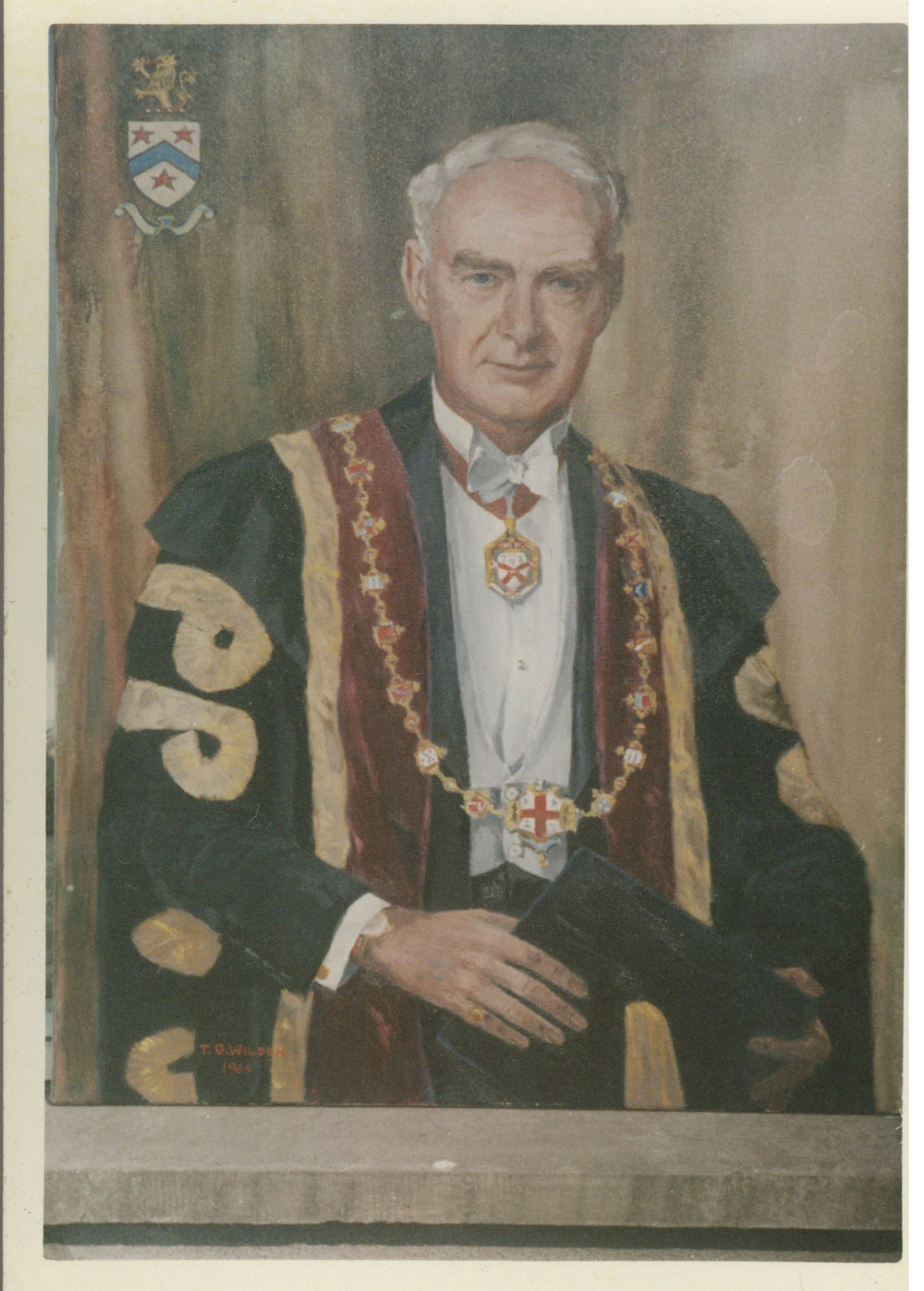
Wilson certainly paid tribute to the figures of some Commissioners who played a fundamental role in Irish Lights, bringing theirexpertise and knowledge over the years such as Robert Callwell, a member of theBallast Board and then a Commissioner; and Robert Ball, Scientific Advisor to the Board and Commissioner.
Commissioner of Irish Lights from 1867 until 1871. Beyond this not much is known about him, but being a Commissioner one of his duties was to participate in Tours of Inspection of Lighthouses, Lightships, Buoys and Beacons around the coast of Ireland. It was during these tours in the 1860s that Callwell wrote and illustrated the two editions of 'History of the Lighthouses of Ireland' and ‘Port of Dublin Corporation: Names etc. of Lightkeepers’. In addition to this he was the artist of over 100 drawings of lighthouses around the coast, 5 of which are held in the Irish Light's Robert Callwell Collection (CAL). Callwell was a skilled artist and, though stylized, his depictions of Lighthouses are detailed and beautiful.
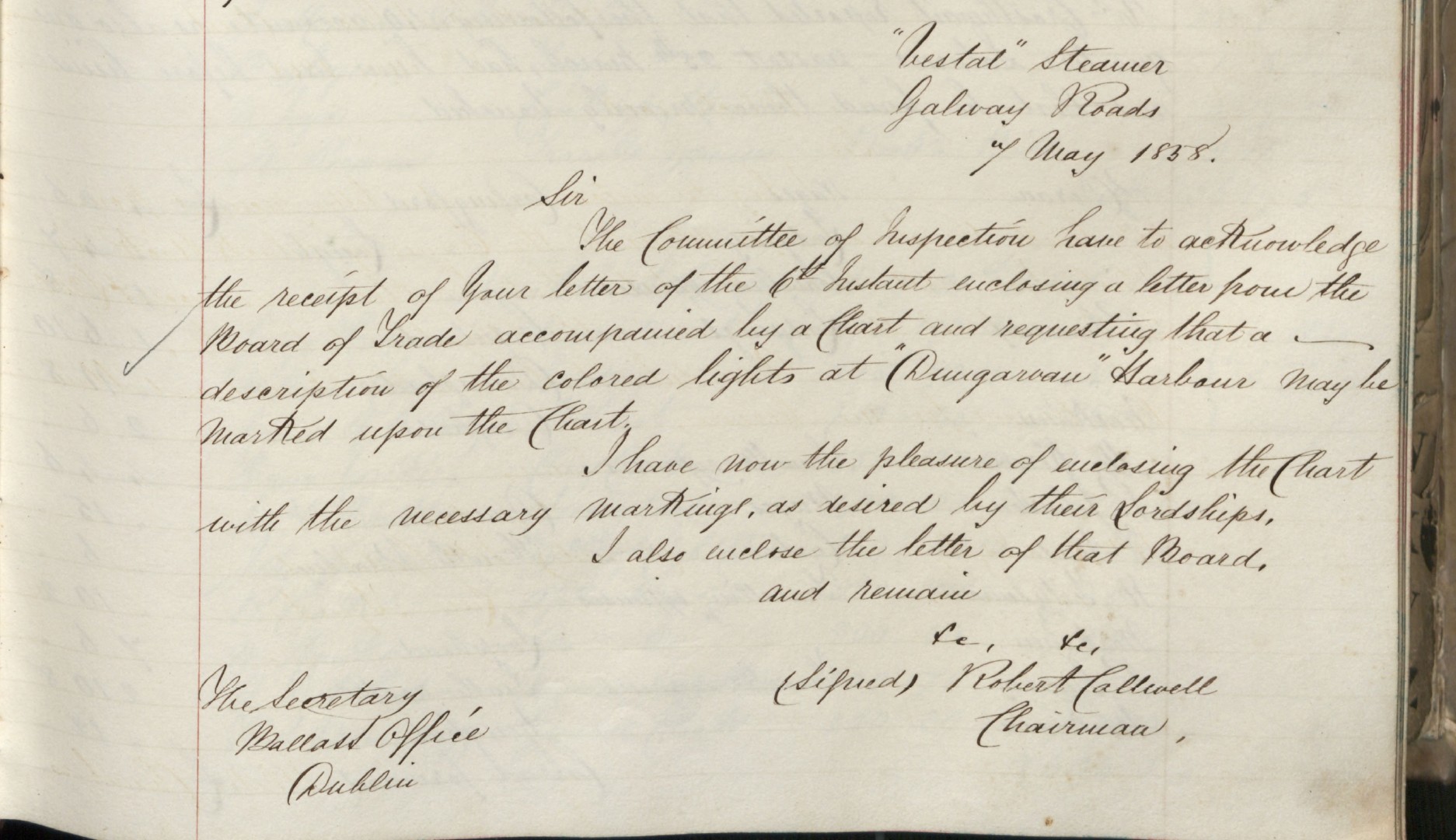
Commissioner of Irish Lights from 1882 until 1884.
He was astronomer, mathematician, photographer, and Scientific Advisor to the Board consulted on several aspects of lighthouse equipment.

B/1/40, Lighthouse Journal N. 40. Robert Ball appointment, 1900
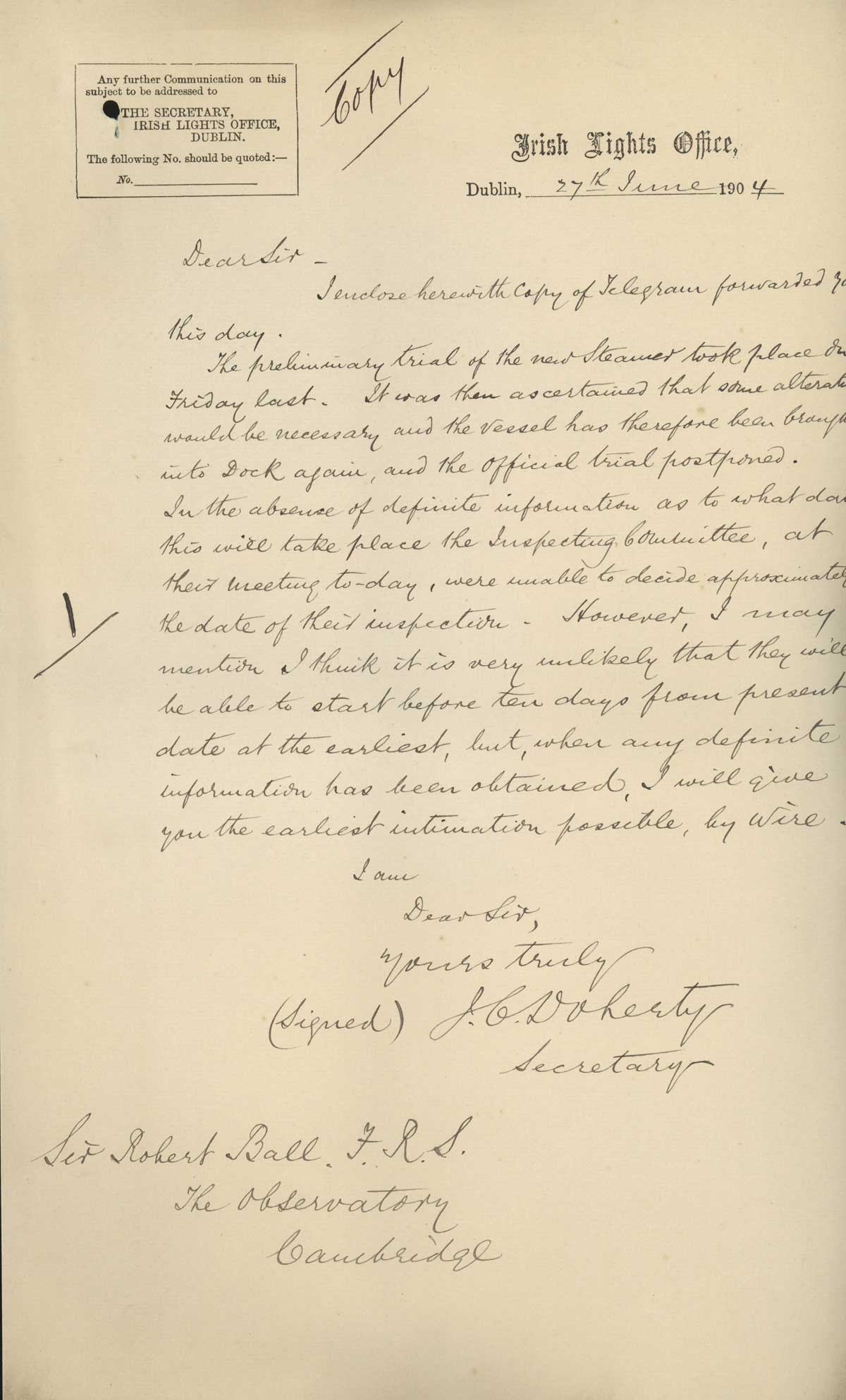
MP/1/2/1159, Inspecting Committee. Robert Ball report, 1904
He was a member of the Inspecting Committee in Irish Lights during whose activity he went around the coast of Ireland each year, and visiting 100 lighthouses and inspecting beacons, buoys, perches, and lightships to ensure that all signalling apparatus was operating properly.
Furthermore, he was incredibly talented amateur photographer, and his time as a member of the Inspecting Committee gave him the opportunity to take photographs of lighthouses and everyday life in remote coastal areas.
(Commissioners of Irish Lights photographic collection is available to access on The National Library of Ireland’s National Photographic Archive (NPA):https://catalogue.nli.ie/Collection/vtls000521026)
Photographs of Robert Ball (R. Ball, Reminiscences of Sir Robert Ball, edited by W. V. Ball 1915)
“He passed peacefully away on November 25th, 1913. Suspended above his deathbed was an almanac in which the favourite mottoes of various eminent men were entered each day of the year. The motto, which he himself had chosen, for November 30th was ‘Happy is the man who has found his work! Let him ask no other blessedness. He has a work, a life purpose; he has found it and will follow it’ ”.
Robert Ball, Reminiscences and Letters of Sir Robert Ball, edited by his son W. Valentine Ball 1915, p. 386
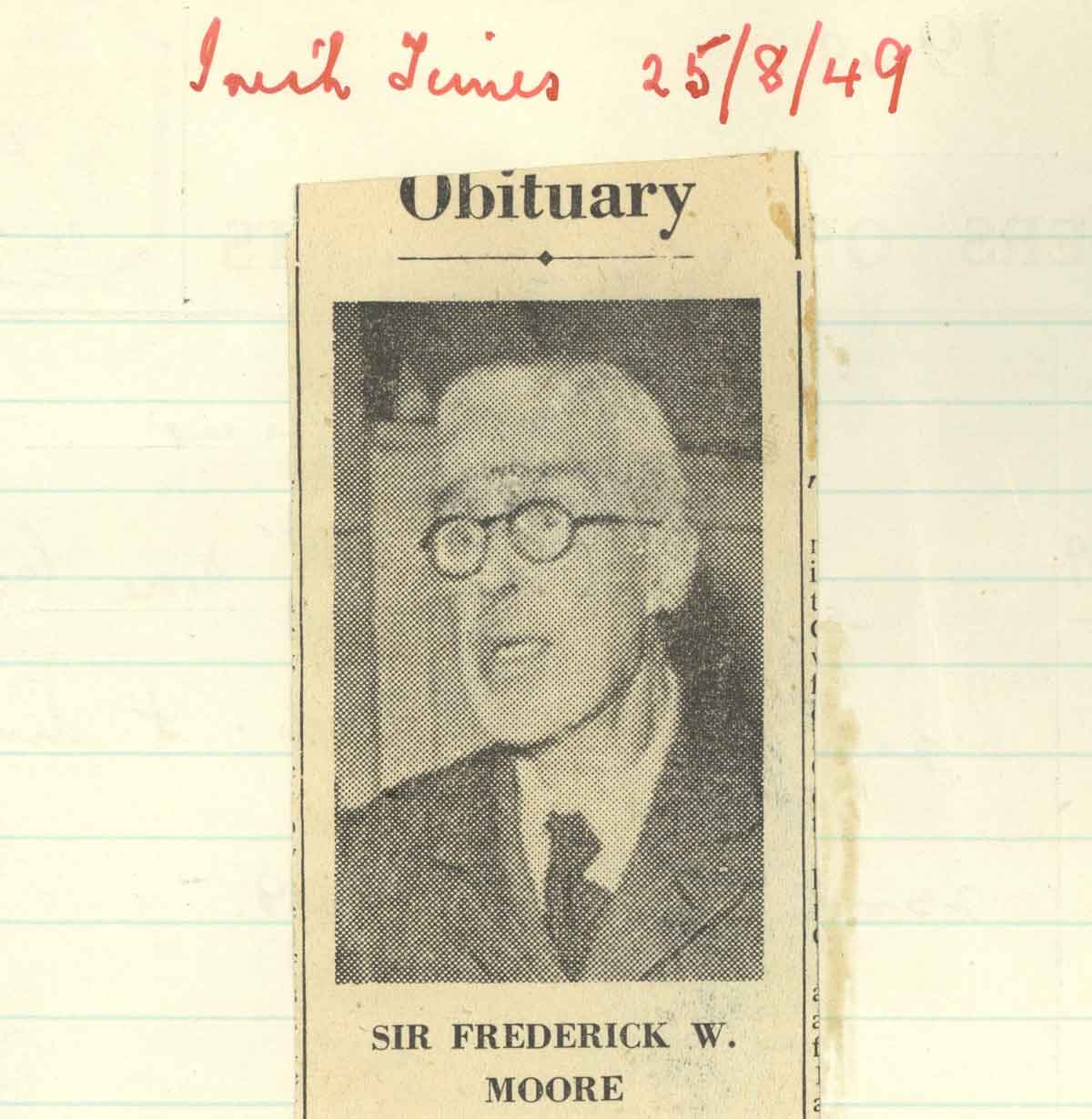
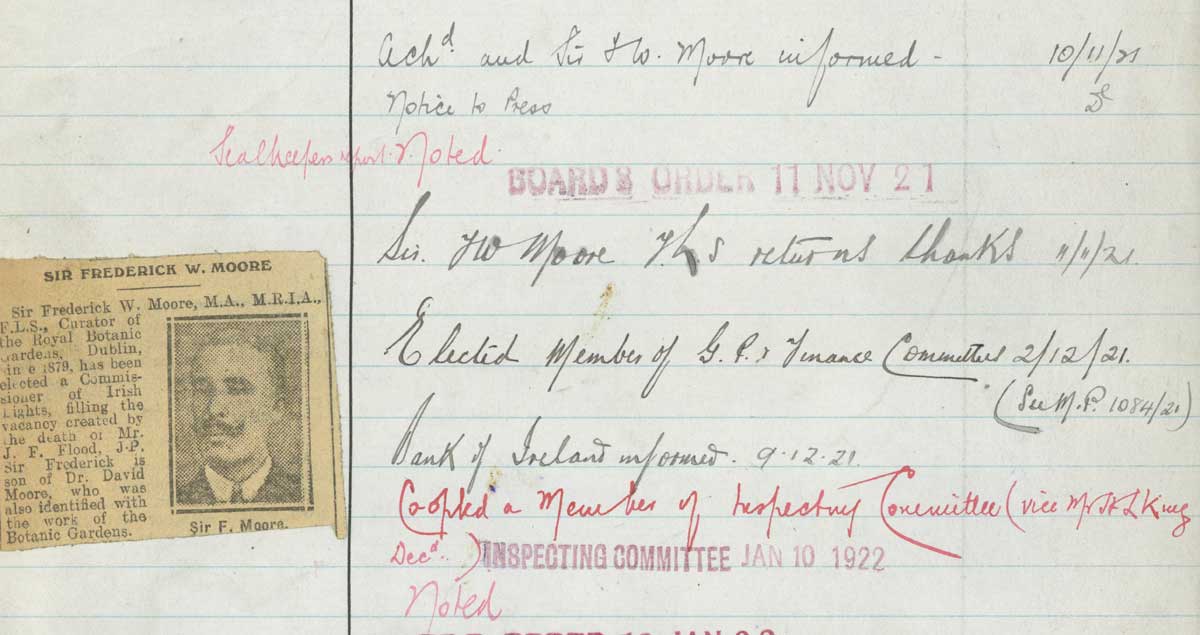
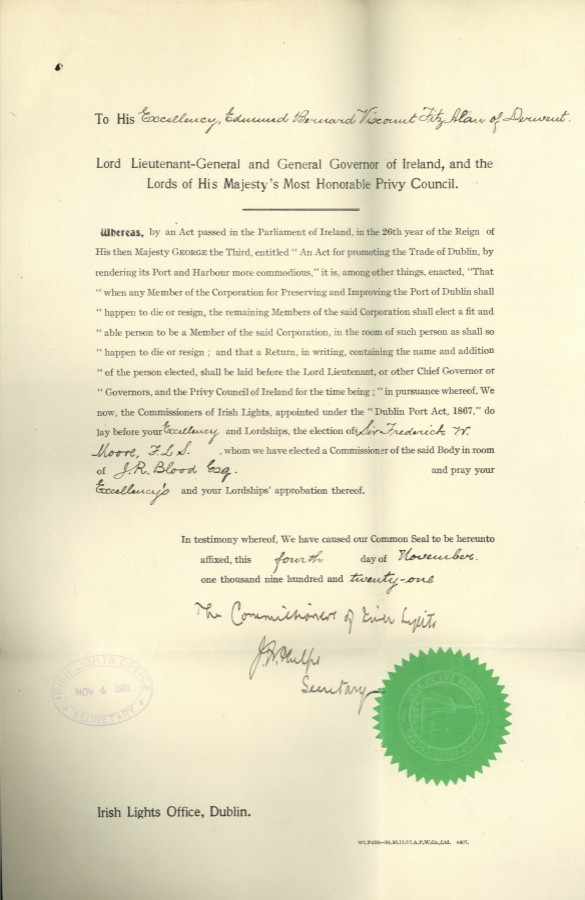
Sir Frederick W. Moore was Commissioners of Irish Lights from 1921 until 1949.He was a fellow of the Linnaean Society and member of the Royal Irish Academy; a past President of the Royal Horticultural Society of Ireland and for five years was president of the Zoological Society and Curator of the Royal Botanic Gardens in Dublin since 1879.
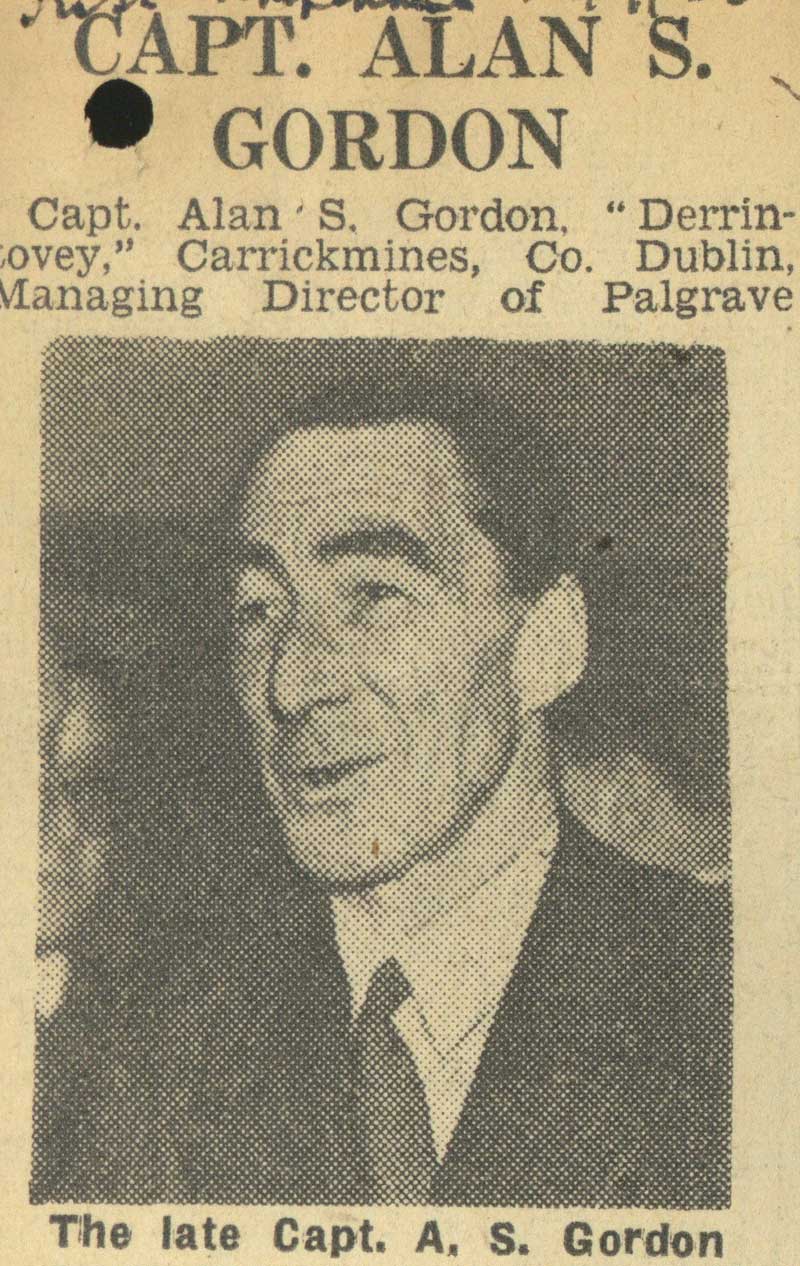
He was a soldier, a sailor, and a lawyer (graduated in law from Cambridge). He was called to the Irish Bar in 1912; when the first World War broke out, he joined up receiving a commission in the beginning of 1915. He served in Egypt until he was retired in June 1919.Entering civilian life, he became connected with Irish shipping interests, and in 1926 he became managing director of Palgrave Murphy Ltd. and in 1934 formed the Saorstat and Continental Steamship Company for the purpose of taking over the ships and interests in the services between Irish Port, Germany, Belgium and Holland. He was also Chairman of the South of Ireland Committee of the Shipping Federation and a member of the Council in London; Chairman of the Master Stevedores Association; Chairman of the Irish Nautical College, and a Director of Irish Shipping Ltd.Among his other activities, he was managing director of Irish Tenders (a company that was under contract to the United States Lines until the service was suspended in 1940); he was also one of the founders of the Liffey Dockyard, and President of the Royal Zoological Society.As was the case for many other Commissioners, he had an interest in the activities of the Royal National Lifeboat Institution.Captain Gordon was described as a man of charming manner and of unusual energy.
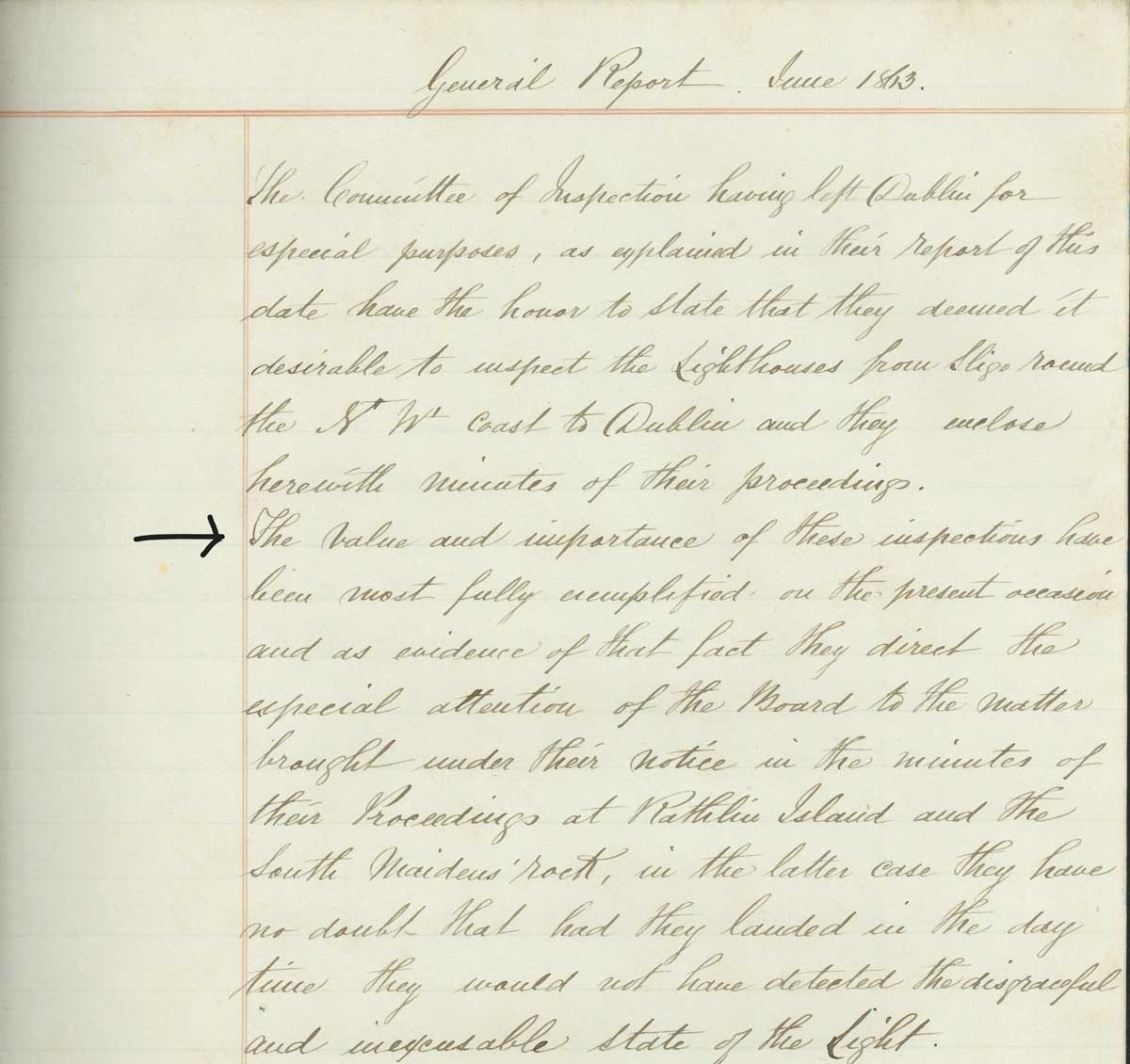
The Commissioners had the great occasion to join the Inspector, the Assistant Inspector and the Deputy Assistant Inspector around the coast of Ireland together for the inspection of the lighthouses during the year, as also did the Engineer-in Chief and his assistants.
Because of their role, they were involved in important matters for the organisation such the discussion about the salary of the staff with Officials of the Board of Trade and attending meetings of Irish Lights Joint Conference and the Annual Lighthouse Conference.
“Every few years, in the course of their annual trip, the Commissioners make what is known as a ‘local inspection'. [..] They are all designed with the sole object of promoting the safety of navigation in the vicinity of our coasts. First of all, we have the lighthouses, large and small, built on lonely islands or headlands, or rising […]. Then we have the lightships, which may be described as floating lighthouses. They mark dangerous rocks or shallow banks. Fog signals arrangements are also to be found in all critical places round the coast. These vary in type from the old-fashioned cannon to the moder siren. It is duty of the Committee to see that all these arrangements are kept up to the mark”.
Robert Ball, Reminiscences and Letters of Sir Robert Ball, edited by his son W. Valentine Ball 1915, pp.251-2
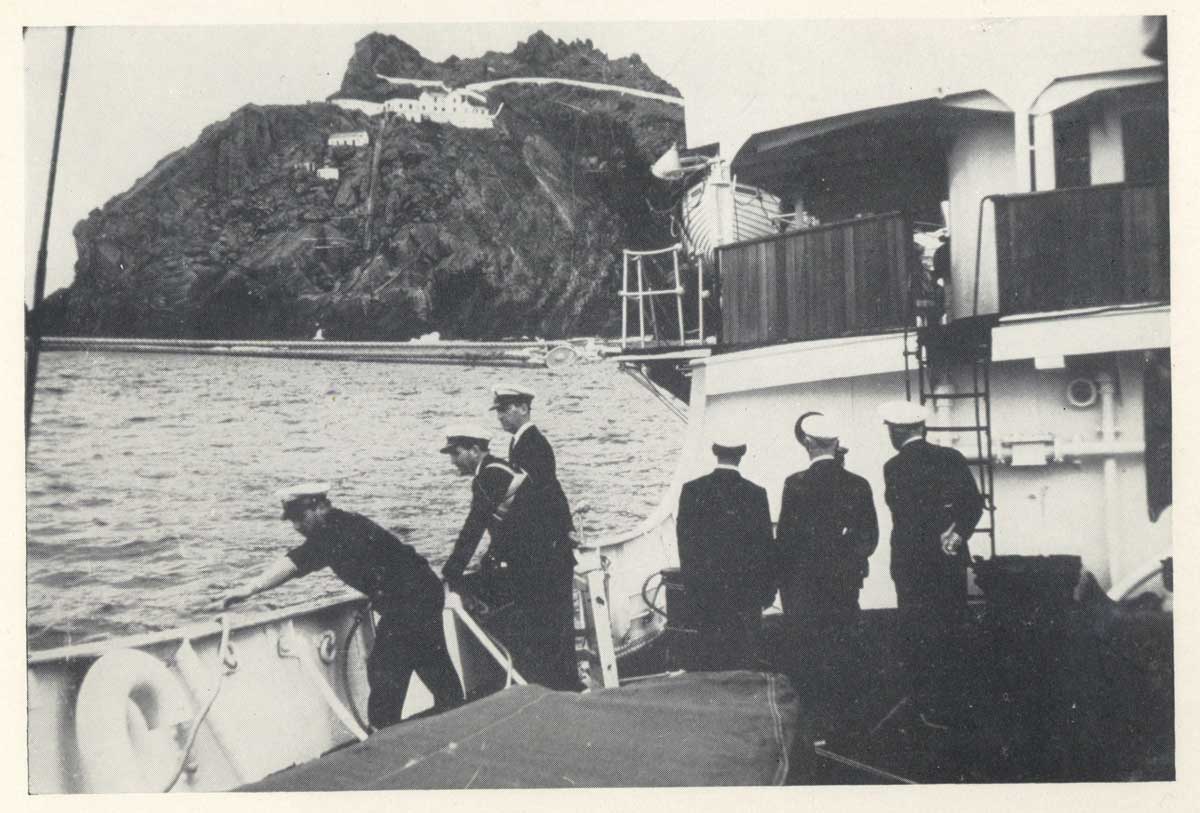
On the foredeck of SS Granuaile preparing to board the launch before landing at Inishtearaght.
From left: E.P. Duffy, A.B; Lyal D. Collen, Commissioner; Desmond Martin, Engineer-in-Chief; Percy G. Adams, Secretary; Sir Walter Edmenson, Commissioner; and Captain J. C. Colvill, R.N. Chairman.
(T.G. Wilson Collection, 1930s-1970)
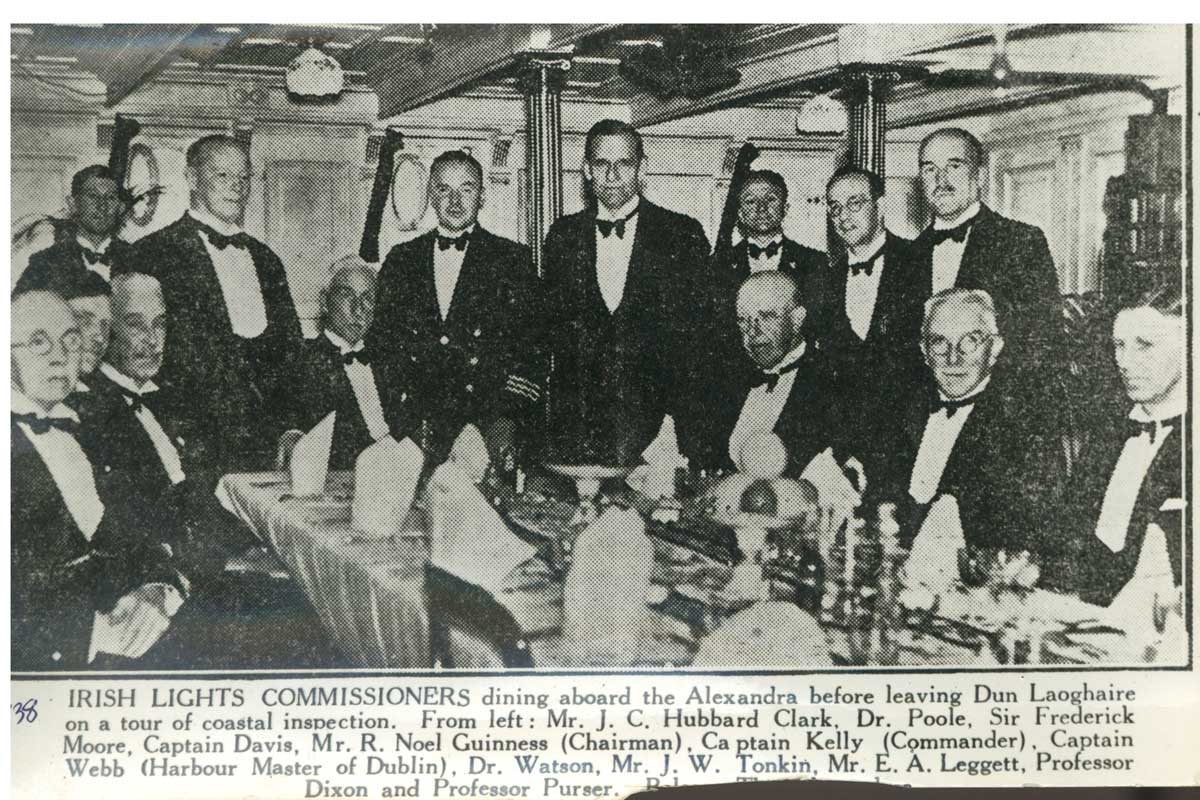
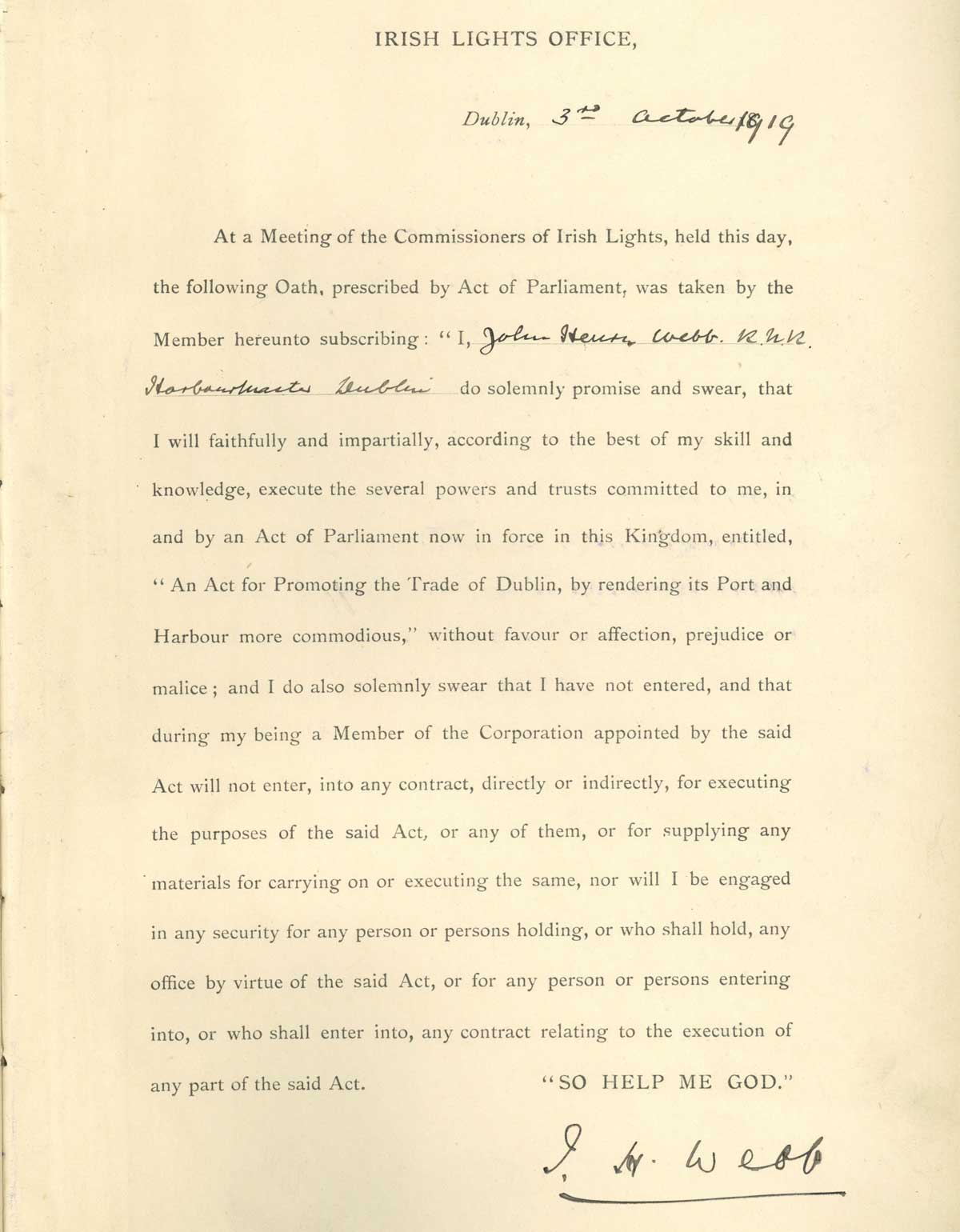
At the time when Wilson was working on the writing of the book, Irish Lights Headquarters was in Lower Pembroke Street in Dublin. The Board met weekly, on Fridays, and committee meetings as often. They were also in charge of interviewing lighthouse keepers who applied for the role.
From the time that the first Commissioner was appointed, in 1867, the following modus operandi for electing the Chairman was in place.
Up until 1917, the third Commissioner to enter the board room took the role of Chair; from 1918 the Board elected a Chairman, Vice-Chairman and Deputy/Vice Chairman.
Following a management restructuring and review of Board procedures the weekly Board meetings were replaced by a monthly meeting from January 1987.
One of the fundamental requirements to become a Commissioner included qualifications in engineering, physics, electronics, labour relations, or navigations.
These people had a professional career on one side and a strong passion for the sea on the other. Many of them were also doctors, members of royal academies, scientific associations, and prestigious institutions in Ireland.
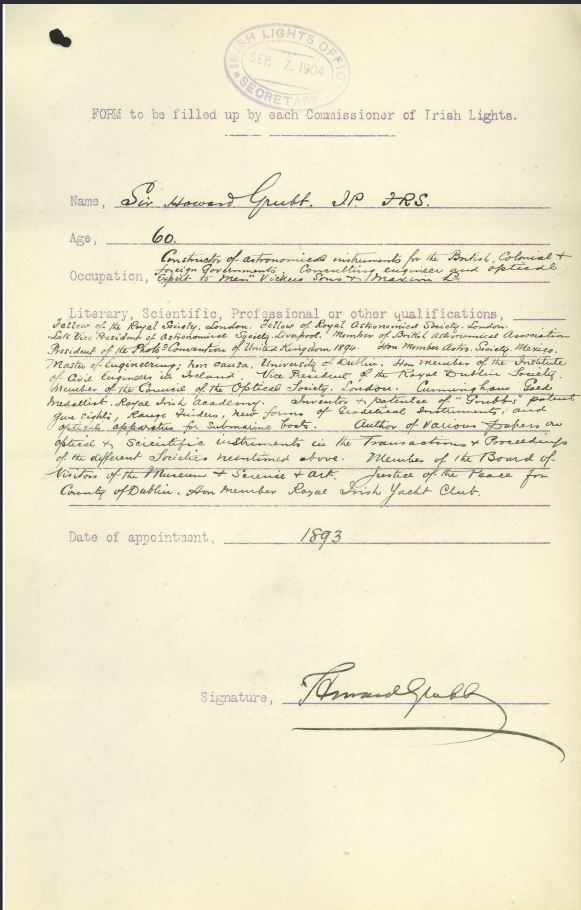
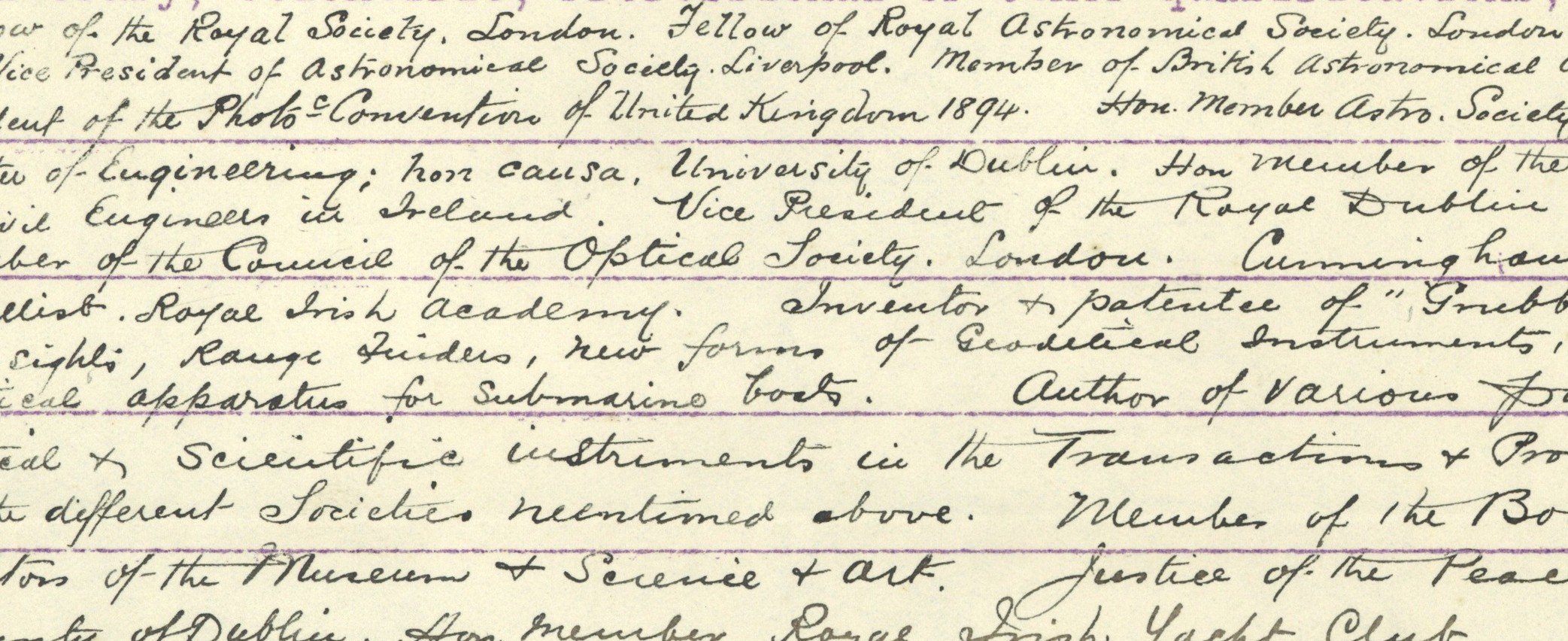
The form to be filled up by each Commissioner of Irish Lights contained name, age, occupation and qualifications.
The role of Commissioners has evolved over time. Today Irish Lights has 12 elected Commissioners, three Commissioners appointed by Dublin City Council and the Lord Mayor.
Collectively, the Commissioners act as the Board of Irish Lights. The 12 elected Commissioners are selected through a public process. They are interviewed by a selection panel which includes representatives of the Department of Transport in Ireland and in the UK and on the recommendation of the Board, they must be endorsed by Government before they can be confirmed. They are appointed for a 5-year term, and they can be reappointed by agreement for a further 5 years.
The Dubin City representatives are nominated by the City Council.On the right, the form signed by Howard Grubb, appointed Commissioner in 1893.
MP/1/3/646, Parliamentary Questions - Commissioners, 1904-1917
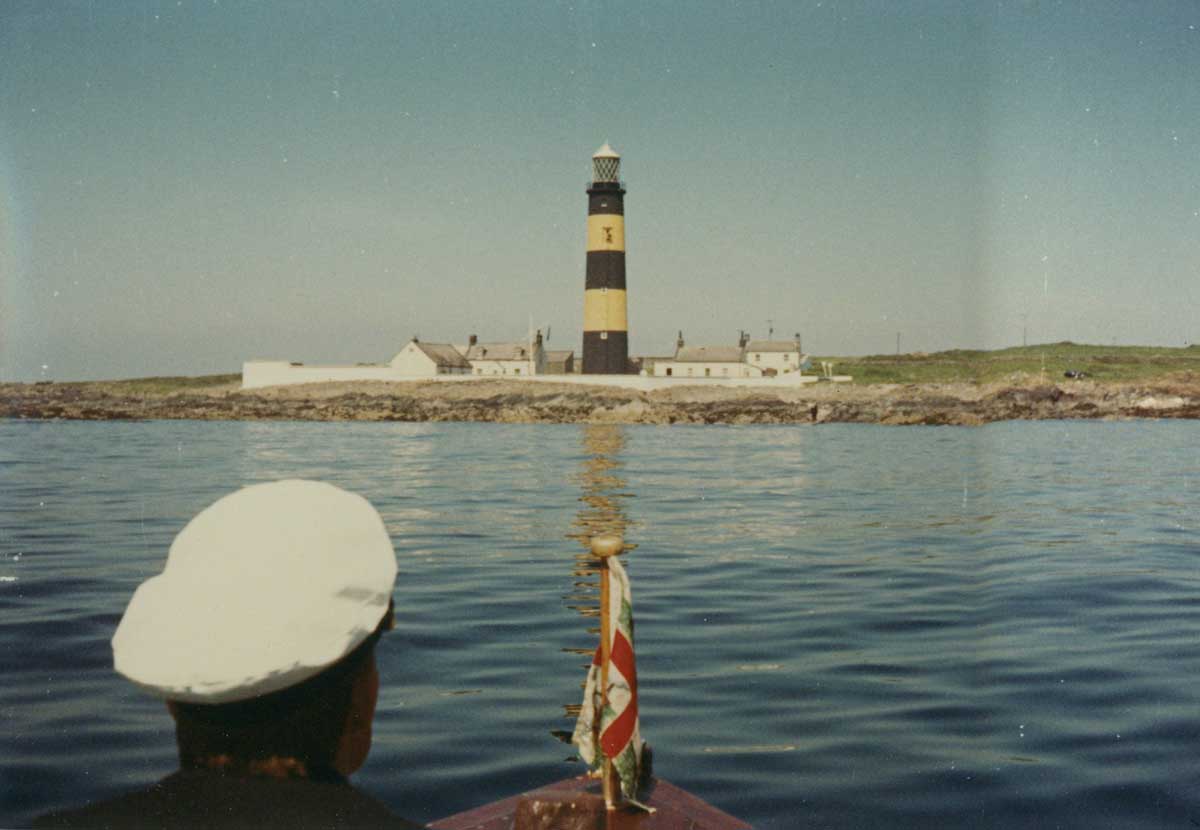
For over 200 years, the Commissioners of Irish Lights has been responsible for ensuring the continuous operation of the lighthouses and the safety of life at sea, protecting the environment and sustaining coastal communities.
Our lighthouses, set on remote headlands and isolated rocks along the coast of Ireland, have stood as guardians of the light, guiding mariners safely through the darkness of their voyages. Irish Lights archive represents a custodian of this heritage, preserving its memory and keeping its “light” alive.
Irish Lights Archive
Board Collection (1810-2005)
Lighthouse Journals Series 1 (1810-1962)
B/1/17, Lighthouse Journal No. 17 (1857-1859)
B/1/40, Lighthouse Journal No. 40, Re-election as Scientific Advisor to the Board (1898-1900)
Board Series (1848-2005)
Minutes of the Proceedings of Committee of Inspection of Lighthouses and Lightships on the coast of Ireland, June 1863
Chairmans, Secretary and Deputy Secretary reports to Board and Inspecting Committee (1966 –1967).
Robert Callwell Collection (1863-1871)
CAL 1/1, Lighthouses of Ireland 1863
Commissioners Collection (1867-1997)
Commissioners’ Oath Books and Nominations Series (1867-1977)
Minute Papers Collection (1868-1954)
MP/1/2/175, Membership of Board (1900)
MP/1/2/1042, Dublin Corporation: Board Representatives (1904)
MP/1/2/1103, Board Members (1904)
MP/1/2/1159, Inspecting Committee (1904)
MP/1/3/646, Parliamentary Questions – Commissioners (1904-1917)
MP/1/4/218, Chairmen and Committees (1917-1920)
MP/1/4/355, Inspecting Committee's Tour of Inspection (1921)
MP/1/6/2080, Sir Frederick W. Moore – Commissioner (1921-1949)
MP/1/7/221, Capt. Alan S. Gordon, Commissioner (1935-1950)
T.G. Wilson Collection (1930s-1970)
Acts
Dublin Port Act, 1867 (Act. 30 Vict. Cap. 80)
Merchant Shipping Act, 1894 (Act. 17 & 18 Vict. 104)
Merchant Shipping (Commissioners of Irish Lights) Act 1997
Bibliography
Ball, Robert S., Reminiscences and Letters of Sir Robert Ball, edited by his son W. Valentine Ball, Cassell and Company Ltd, London, New York, Toronto and Melbourne 1915
Wilson, T.G, The Irish Lighthouse Service, published by Allen Figgis, Dublin 1968
Websiteshttps://www.dib.ie/biography/wilson-thomas-george-a9080https://www.newulsterbiography.co.uk/index.php/home/viewPerson/2082

